


Laudakia stellio brachydactyla - Painted agama
The information on this page is based on data from scientific publications, specialized literature, the experience of long-term keepers, and my own practical experience. If you have any comments, suggestions, or questions, feel free to get in touch.
Taxonomy and systematic position
Laudakia stellio brachydactyla belongs to the stellio (rock agama) species complex, a group of medium-sized agamid lizards distributed across the Eastern Mediterranean and Middle East. In older literature it is usually treated as a subspecies of Laudakia stellio, commonly referred to in English as the Starred agama, Rough-tailed rock agama, or simply Rock agama. Animals from the southern Levant and Sinai region, corresponding to brachydactyla, are often called the Levant rock agama or Painted agama in the hobby, referring to their vivid breeding colours.
Recent multilocus phylogenetic research has shown that the traditional Laudakia stellio concept actually consists of several deeply divergent evolutionary lineages. These lineages show consistent genetic differences that broadly match geography and previously described subspecies. As a result, forms such as brachydactyla are now understood to represent distinct evolutionary units, and future taxonomic revisions may elevate some of them to full species status.
For keepers, this taxonomic insight is important: populations currently grouped under the same name may differ subtly in size, coloration, behaviour, and ecological preferences. Treating Laudakia stellio brachydactyla as a geographically and biologically distinct form helps ensure more accurate husbandry, breeding projects, and record-keeping within captive populations.
Morphology and general appearance
Laudakia stellio brachydactyla is a robust, medium-sized rock agama with a powerful build and a distinctly flattened body adapted to life on rocks and stone walls. The head is broad and triangular, with strong jaws and well-developed temporal musculature. Limbs are sturdy and relatively short, a feature reflected in the name brachydactyla, and the toes end in strong claws that provide excellent grip on rough surfaces.
The tail is thick at the base, clearly spiny, and often shows subtle banding. Dorsal scalation is coarse and heterogeneous, giving the animal a rugged appearance that blends well with rocky environments. Base coloration outside the breeding season typically ranges from grey and brown to sandy beige, often with darker mottling or banding that provides effective camouflage.
During the breeding season, adult males become strikingly colourful. The head, neck, and anterior body can develop vivid shades of blue, turquoise, orange, yellow, and black, earning them the common name “painted agama” among keepers. Females and juveniles remain more cryptically coloured, though they may show patterning and warm tones.

Sexual dimorphism and sex determination
Sex determination in L. s. brachydactyla becomes reliable from approximately six months of age, depending on growth rate and nutritional condition. Adult males possess enlarged preanal pore scales, typically arranged in three to five rows, as well as medioventral pore scales along the midline of the belly. Males are generally slightly larger than females, have broader heads, and display more intense coloration, particularly during the breeding season. Females are usually paler and lack strongly developed pore structures, while juveniles show little to no sexual dichromatism.
Distribution and biogeography
The distribution of Laudakia stellio brachydactyla extends from northern Saudi Arabia through southern Israel and the Sinai Peninsula to Egypt and Jordan. Across this range, the species inhabits regions with markedly different climatic conditions, from hot semi-desert lowlands to higher-altitude areas that experience cool winters and, in some locations, snowfall.
This broad ecological range explains the considerable variation observed between populations in seasonal activity, winter rest duration, and reproductive timing. These differences are of direct relevance to captive breeding, as they influence how strongly seasonal cycling needs to be expressed under artificial conditions. Click on the image on the right to be redirected to the website of the Zoological journal of the Linnean society, where you can see the authors and read the full article.

Natural habitat and ecology
In the wild, L. s. brachydactyla occupies predominantly rocky and structurally complex habitats. These include rocky hillsides and escarpments, scree slopes and stone accumulations, wadis and semi-desert landscapes, as well as ruins, stone walls, bridges, and other man-made structures. In some regions, individuals are also found in open woodland and on old trees.
The species is strongly saxicolous and relies primarily on rock surfaces rather than loose soil or dense vegetation. Elevated basking sites play a central role in daily activity, providing optimal exposure to sunlight and allowing clear visual control of the surroundings. Retreat sites are typically located in narrow rock crevices, beneath stones, or within walls and ruins.

Behaviour and social organization
This species exhibits strong territorial behaviour, especially in adult males. In nature, dominant males occupy the most favorable basking sites within a territory and actively defend them against rivals. Display behaviour includes rhythmic head bobbing, inflation of the body, elevation of the forebody, and coordinated limb movements.
Territorial encounters typically begin with visual displays and may escalate into physical confrontations involving biting. Despite their intensity, such encounters rarely result in serious injuries, as they usually end with the retreat of the subordinate individual. In captivity, the same behavioural patterns are observed. For this reason, only one male should be housed per enclosure, accompanied by one or two females. Males must never be housed together. The animals are highly alert and visually oriented, remaining vigilant throughout the day, with captive-bred individuals generally acclimating more readily to human presence than wild-caught specimens.
Enclosure size and structural design
Although official minimum enclosure sizes exist, these should be regarded as absolute lower limits only. For long-term health, natural behaviour, and successful reproduction, Laudakia stellio brachydactyla requires large, vertically structured enclosures. For a pair or a 1.2 group, a minimum enclosure size of 120 × 60 × 120 cm is recommended, with larger enclosures—especially those offering increased height—being strongly preferable.
The enclosure should encourage movement in three dimensions and reflect the species’ natural use of vertical space. Extensive rock terraces and ledges, multiple basking sites at different elevations, near-vertical background structures for climbing, and secure hiding places in crevices and beneath stones are essential. A sand–loam or sand–stone substrate with a depth of 10–15 cm is suitable, while optional planting with non-toxic species can provide visual barriers, shade, and environmental enrichment.
If climatic conditions allow, Laudakia stellio brachydactyla can also be maintained in an outdoor enclosure for part of the year. Outdoor housing offers clear benefits, including exposure to unfiltered natural sunlight, natural day–night rhythms, and increased opportunities for thermoregulation and physical activity. These factors can have a positive effect on overall condition, coloration, and behavior.
The period during which outdoor keeping is feasible depends strongly on the local climate. In warmer regions with stable summer temperatures, animals may be housed outdoors for several months, whereas in cooler or more variable climates this period may be limited to short summer windows only. Outdoor enclosures must provide ample basking opportunities, secure shelters, protection from rain and excessive humidity, and safeguards against predators and overheating. Animals should be transferred indoors well before night temperatures drop to critical levels, as prolonged exposure to low temperatures can compromise health.
When managed carefully and adapted to regional climatic conditions, seasonal outdoor housing can be a valuable addition to the husbandry of Laudakia stellio brachydactyla.
Lighting and thermal environment
Light is the single most critical factor in the successful maintenance of this strongly heliophilous species. Very high light intensity must be combined with appropriate ultraviolet radiation. Daytime ambient temperatures should range between 25 and 30 °C, with localized basking sites reaching 40–50 °C. At night, temperatures may drop to room temperature or lower during brumation.
High-output daylight-spectrum lighting, powerful heat sources to establish clear thermal gradients, continuous UVB availability for calcium metabolism, and UVA exposure to stimulate natural basking and activity are all indispensable. During summer, a photoperiod of approximately fourteen hours is appropriate, with gradual seasonal adjustments in spring and autumn.
Humidity and water balance
Although originating from arid environments, humidity plays an important physiological role. A relative humidity of 30–50% is appropriate and can be maintained through misting every one to two days, preferably in the morning. A shallow water dish should always be available. In nature, hydration is primarily achieved through dew, occasional rainfall, and moisture obtained from food rather than frequent drinking.
Nutrition and feeding strategy
Laudakia stellio brachydactyla is omnivorous, with animal prey forming the majority of the diet. In captivity, locusts, crickets, cockroaches, beetles, larvae, flies, and seasonal meadow plankton are readily accepted and nutritionally valuable. Plant matter, including leafy greens, weeds, and edible flowers, should be offered regularly, finely chopped and appropriate to the size of the animals. Calcium and vitamin supplementation is highly recommended.

Reproduction and breeding
Under appropriate conditions, breeding Laudakia stellio brachydactyla in captivity is well achievable. Sexual maturity is typically reached between twelve and eighteen months of age, though consistent breeding results are best obtained from animals at least eighteen months old and in good physical condition. Reproductive activity is commonly initiated by a period of winter rest lasting approximately six to ten weeks, during which temperatures are reduced to 8–12 °C, lighting is minimized or switched off, and feeding is suspended while water remains available.
Reactivation occurs gradually over one to two weeks, after which a photoperiod of thirteen to fourteen hours, ambient temperatures of 25–30 °C, and basking sites of 40–50 °C are restored. Courtship and copulation typically begin within one to three weeks after reactivation. Females usually deposit eggs three to five weeks after copulation in a slightly moist, well-drained sand–loam substrate. Clutches generally consist of five to twelve elongated, soft-shelled eggs, and well-conditioned females may produce two, occasionally three, clutches per season, with intervals of four to six weeks. Excessive clutch production should be avoided to preserve long-term health.
Incubation and sex determination
The mechanism of sex determination in Laudakia stellio brachydactyla has not yet been conclusively established. One scientific publication suggests that incubation temperature may influence sex ratios in this species, although this claim is presented without detailed data or referenced methodology. Independent of this, several experienced and independent breeders have reported similar observations, indicating a consistent, non-random relationship between incubation temperature and resulting sex ratios.
Based on these reports and preliminary observations, a working hypothesis has emerged in which incubation at approximately 27 °C tends to produce predominantly female offspring, while incubation at around 29 °C appears to result in a higher proportion of males. At present, this relationship should be regarded as plausible but unconfirmed. Further controlled incubation of multiple clutches at different temperatures, while keeping all other variables constant, is required to determine whether true temperature-dependent sex determination is present and to define any pivotal temperature range.
Annual cycle and winter rest
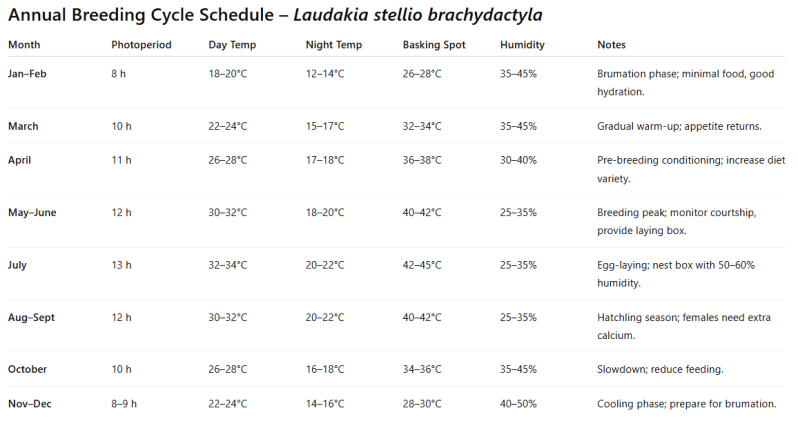
Laudakia stellio brachydactyla exhibits a pronounced annual physiological rhythm closely linked to environmental temperature and photoperiod. The duration and intensity of winter rest vary according to geographic origin, with northern or high-altitude populations often requiring several months of reduced activity, while southern populations may show only brief or partial inactivity. Winter rest plays an important role in spermatogenesis and reproductive readiness, and breeding behaviour typically resumes shortly after reactivation. Winter rest should not be applied to sick or weakened animals.
Longevity and breeding significance
Under well-managed, naturalistic conditions, Laudakia stellio brachydactyla can reach a lifespan of ten to fifteen years. With captive-bred specimens now more available, responsible breeding efforts should focus on the use of CB animals, the maintenance of traceable bloodlines, and conservation-oriented husbandry practices, thereby reducing pressure on wild populations.
Create Your Own Website With Webador